
Last Updated: March25, 2026
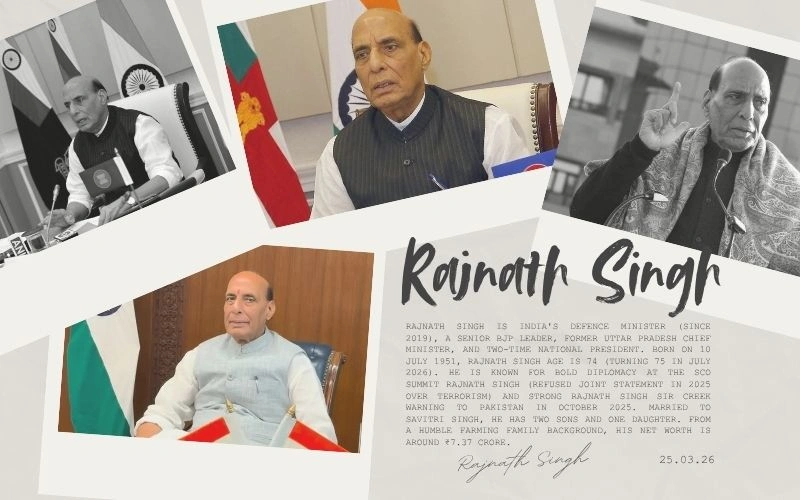
Rajnath Singh is India’s Defence Minister (since 2019), a senior BJP leader, former Uttar Pradesh Chief Minister, and two-time National President. Born on 10 July 1951, Rajnath Singh Age is 74 (turning 75 in July 2026). He is known for bold diplomacy at the Sco Summit Rajnath Singh (refused joint statement in 2025 over terrorism) and strong Rajnath Singh Sir Creek warning to Pakistan in October 2025. Married to Savitri Singh, he has two sons and one daughter. From a humble farming family background, his net worth is around ₹7.37 crore.
Disclaimer: This biography of Rajnath Singh is compiled solely from publicly available, verified information sourced from official records, government websites, credible news outlets, and his election affidavits as of March 2026. Every effort has been made to ensure factual accuracy and neutrality. The article is intended only for informational and educational purposes. It does not claim to be exhaustive or official. Readers are advised to cross-verify the latest details from primary sources. The authors and publishers are not responsible for any errors, omissions, or changes that may occur after the publication date. No part of this content should be construed as political endorsement or legal advice.
Quick Facts / At a Glance
| Detail | Information |
|---|---|
| Full Name | Rajnath Singh |
| Born | July 10, 1951, Bhabhaura village, Chandauli, Uttar Pradesh, India |
| Age (as of 2026) | 74 years |
| Profession / Occupation | Politician, Former Lecturer (Physics) |
| Famous For | Union Defence Minister of India, BJP National President (twice), CM of Uttar Pradesh |
| Father | Ram Badan Singh |
| Mother | Gujarati Devi |
| Brother | Jaipal Singh |
| Nationality | Indian |
| Caste | Rajput (Thakur) |
| Education | M.Sc. Physics (First Division), Gorakhpur University |
| Political Party | Bharatiya Janata Party (BJP) |
| Key Achievements | 29th Defence Minister of India, 25th Home Minister (first post-Independence born), BJP President (2005–09, 2013–14), CM of Uttar Pradesh (2000–02) |
| Wife | Savitri Singh (married June 5, 1971) |
| Son | Pankaj Singh (MLA, Noida, UP), one more son |
| Daughter | One daughter |
| Net Worth (2025–26) | Approx. ₹7.37–7.80 crore (as per 2024 Election Commission affidavit) |
| Current Role | Minister of Defence, Government of India (since May 31, 2019) |
| Lok Sabha Constituency | Lucknow, Uttar Pradesh |
Early Life: From a Village in Uttar Pradesh to National Politics
Roots in the Heartland of India
Rajnath Singh was born in Bhabhaura village of Chandauli district, Uttar Pradesh, to his father Ram Badan Singh and mother Gujarati Devi — a family rooted in farming and simplicity. The agrarian background left a lasting imprint on his worldview, instilling values of hard work, frugality, and a deep connection to rural India.
Growing up in the Bhojpuri-speaking belt of eastern UP, young Rajnath was exposed to the rhythms of a traditional Indian household — one that believed in collective duty over personal ambition. His Rajnath Singh caste identity as a Rajput (Thakur) placed him within a community that has historically prized valor, dignity, and public service, values that would later define his political persona.
Early Inspiration from the RSS
From childhood, Singh was inspired by the ideology of the Rashtriya Swayamsevak Sangh. He had been associated with the RSS since 1964, at the age of 13, and remained connected with the organisation throughout his formative years. He became Shakha Karyavah (General Secretary) of Mirzapur in 1972.
This early ideological grounding through the RSS shaped not just his politics but his temperament — methodical, principled, and deeply committed to what he views as civilisational values. Unlike many who enter politics through inheritance or opportunism, Rajnath Singh’s journey was paved by decades of grassroots organisational work.
Rajnath Singh Family Background
The Family That Shaped a Leader
Understanding Rajnath Singh family dynamics is essential to understanding the man. He was raised in a joint farming family in Chandauli, one of Uttar Pradesh’s less developed districts. The family’s agricultural background meant that public service, not wealth accumulation, was the benchmark for success.
| Family Member | Identity / Role |
|---|---|
| Father | Ram Badan Singh — farmer, Chandauli, UP |
| Mother | Gujarati Devi — homemaker |
| Brother | Jaipal Singh |
| Wife | Savitri Singh (married June 5, 1971) |
| Son 1 | Pankaj Singh — BJP MLA, Noida constituency, Uttar Pradesh Legislative Assembly |
| Son 2 | Second son (private life) |
| Daughter | One daughter (maintains private life) |
Rajnath Singh Wife: Savitri Singh
Rajnath Singh wife Savitri Singh has been his lifelong partner. He married her on June 5, 1971, and together they have two sons and a daughter. Savitri Singh has consistently maintained a low public profile, embodying the quiet strength that complements her husband’s public-facing role.
Their marriage has spanned over five decades of political turbulence, social change, and national crises — a testament to a bond built on shared values and mutual respect rather than public performance.
Rajnath Singh Son: Pankaj Singh
The most publicly prominent member of the Singh family after Rajnath himself is undoubtedly Rajnath Singh son Pankaj Singh. Pankaj Singh is a politician and Member of the Legislative Assembly from the Noida constituency of Uttar Pradesh, representing the BJP. Pankaj has carved his own political identity within the party, winning multiple MLA elections from one of Uttar Pradesh’s most urbanised and competitive constituencies. His political trajectory is closely watched as an indication of the next generation’s role in the BJP.
Rajnath Singh Daughter
Rajnath Singh daughter maintains an intensely private life and has stayed well away from political or public spotlights. This approach reflects the broader family ethos — public service is Rajnath Singh’s calling, but family life remains sacred and separate.
Rajnath Singh Education: The Physicist Who Became a Politician
Academic Foundations
Rajnath Singh education began at a local school in his village. He went on to secure a master’s degree in physics from Gorakhpur University, achieving first-division results — a significant academic accomplishment for a young man from a rural farming family.
The M.Sc. in Physics was not merely a credential — it instilled in him an analytical, evidence-based approach to complex problems. This scientific temperament would later manifest in his methodical approach to policy, his precision in parliamentary debate, and his careful assessment of military strategy.
From Classroom to Grassroots Politics
After completing his education, Singh worked as a lecturer of Physics at K.B. Post-Graduate College in Mirzapur, Uttar Pradesh. The teaching experience was formative — it gave him communication skills, patience, and the ability to simplify complex ideas, all of which serve him in his political career to this day. Between 1969 and 1971, he was simultaneously serving as the organisational secretary of the Akhil Bharatiya Vidyarthi Parishad (ABVP) in Gorakhpur, building the twin pillars of intellectual rigour and ideological commitment that define his public life.
Career Journey: Rajnath Singh’s Political Ascent
Entry into Politics and the Emergency Era (1974–1977)
Rajnath Singh was appointed secretary of the Bharatiya Jana Sangh, Mirzapur (UP) unit in 1974, marking his formal entry into politics. He was elevated to the post of District President of Janasangh, Mirzapur in UP in 1975. That same year, he was arrested and detained for participating in the JP movement during the Emergency.
His detention during the Emergency period declared by Prime Minister Indira Gandhi was not a setback — it became a badge of honour. Many leaders of his generation who stood up to authoritarianism during this period emerged with extraordinary moral credibility. Singh’s imprisonment only deepened his commitment to democratic values and constitutional governance.
First Electoral Victory and State Leadership (1977–1991)
In 1977, Rajnath Singh successfully contested his maiden election and became an MLA from Mirzapur (UP) as a Janata Party candidate. This victory launched a career that would span five decades of continuous relevance.
In 1983, he became State Secretary of UP BJP. In 1984, he became the state president of the BJP’s youth wing, Bharatiya Janata Yuva Morcha (BJYM). In 1986 he became BJYM’s national general secretary, and in 1988 he was appointed as the organisation’s national president.
In 1988, Rajnath Singh was elected a member of the Legislative Council of Uttar Pradesh. In 1991, he became Education Minister of Uttar Pradesh.
Education Minister of UP: Landmark Decisions (1991–1992)
As Education Minister, Singh introduced several policies that generated both praise and controversy. He championed the introduction of Vedic Mathematics into the school curriculum and passed the landmark Anti-Copying Act in 1992, aimed at curbing the rampant culture of cheating in examinations. While he was serving in that office, the party undertook a controversial program of rewriting portions of history and mathematics textbooks to reflect a more religious viewpoint. The Anti-Copying Act’s resulting lower graduation rates and public arrests of alleged cheaters sparked protests, and the law was later repealed.
The episode demonstrated a key facet of Singh’s character: he pursues what he believes is right, even at political cost.
Rajya Sabha, Surface Transport and Agriculture (1994–2004)
Singh became a member of the Rajya Sabha in 1994. In 1997, he was appointed president of the Uttar Pradesh branch of the BJP, and in late 1999 he was back in New Delhi as the minister of Surface Transport under the BJP-led National Democratic Alliance (NDA) government. During his time with the ministry, an ambitious program was unveiled to expand the national highway network to better link India’s major urban areas.
In his role as Union Minister of Surface Transport, he initiated the NHDP (National Highway Development Programme), a dream project of Prime Minister Atal Bihari Vajpayee. This initiative would eventually become the bedrock of India’s modern highway infrastructure.
In 2003, Rajnath Singh became Minister of Agriculture in Vajpayee’s cabinet. As Union Minister of Agriculture and subsequently for Food Processing, he spearheaded epoch-making projects like Kisan Call Centre and Farm Income Insurance Scheme.
Chief Minister of Uttar Pradesh (2000–2002)
In 2000, Singh became the chief minister of Uttar Pradesh, succeeding veteran leader Ram Prakash Gupta. His tenure in office lasted less than a year and a half, however, as he was forced to step down in early 2002 after the BJP lost control of the government in state assembly elections.
Despite its brevity, his tenure as Chief Minister of India’s most populous state remains a significant chapter in his career. He managed a complex administrative machinery while simultaneously navigating intraparty dynamics — an experience that prepared him for the national stage.
BJP National President: Twice (2005–2009 & 2013–2014)
Singh was the President of the Bharatiya Janata Party from 2005 to 2009 and again from 2013 to 2014. His two terms as BJP President are among the most consequential in the party’s history.
During his first term, he worked to rebuild the party after the NDA’s 2004 electoral defeat, refocusing it on Hindutva ideology and grassroots mobilisation. He took the bold step of suspending senior leader Jaswant Singh from the party, demonstrating his willingness to enforce party discipline even when politically uncomfortable.
His second term, from 2013 to 2014, was arguably even more consequential — he played a central role in the historic campaign that brought Narendra Modi to power with an absolute majority in 2014, the BJP’s greatest electoral triumph.
Union Home Minister (2014–2019)
Before this, he was the Home Minister from 2014 to 2019. He was the first person born after India became independent to hold this important job. As Home Minister, Singh oversaw significant developments in internal security, counterterrorism, and border management. He commissioned the Bastariya Battalion on May 21, 2018 — a regiment of CRPF recruited from tribal communities to help counter Naxalism in Chhattisgarh.
His tenure as Home Minister was defined by a firm but measured approach — tough on security threats, yet attentive to the human dimension of India’s internal conflicts.
Defence Minister Rajnath Singh (2019–Present)
Singh became the Defence Minister of India on May 31, 2019, after Amit Shah was given the Ministry of Home Affairs. This role has defined his most consequential chapter yet. Under his watch, India has expanded its defence manufacturing ecosystem, received Rafale fighter jets, navigated the 2020 Galwan Valley standoff with China, managed the 2025 Pahalgam attack and Operation Sindoor, and maintained strategic autonomy in an increasingly multipolar world.
Career Timeline
| Year | Event | Details |
|---|---|---|
| 1964 | Joined RSS | Associated with Rashtriya Swayamsevak Sangh at age 13 |
| 1969–71 | ABVP Organising Secretary | Served in Gorakhpur, UP |
| 1972 | Shakha Karyavah | Appointed RSS General Secretary, Mirzapur |
| 1974 | Entered Formal Politics | Secretary, Bharatiya Jana Sangh, Mirzapur |
| 1975 | Jailed during Emergency | Arrested for participating in JP Movement |
| 1977 | First MLA Victory | Elected from Mirzapur as Janata Party candidate |
| 1983 | State Secretary, BJP UP | Strengthened party in Uttar Pradesh |
| 1984 | BJYM State President | Headed BJP Youth Wing, Uttar Pradesh |
| 1988 | BJYM National President | Led BJP’s national youth organisation |
| 1988 | UP Legislative Council | Elected member of the Upper House in UP |
| 1991 | Education Minister, UP | Introduced Anti-Copying Act, Vedic Mathematics |
| 1994 | Rajya Sabha Member | Entered national Parliament’s Upper House |
| 1997 | BJP UP President | Led party affairs in Uttar Pradesh |
| 1999 | Union Minister, Surface Transport | Launched NHDP under PM Vajpayee |
| 2000–02 | Chief Minister, UP | Led India’s most populous state |
| 2003–04 | Union Agriculture Minister | Kisan Call Centre, Farm Income Insurance |
| 2005–09 | BJP National President (1st Term) | Rebuilt BJP after 2004 defeat |
| 2009 | MP from Ghaziabad | Entered Lok Sabha for first time |
| 2013–14 | BJP National President (2nd Term) | Spearheaded 2014 election campaign |
| 2014–19 | Union Home Minister | First post-Independence born to hold office |
| 2019–Present | Union Defence Minister | 29th Defence Minister of India |
| 2025 | SCO Summit, Qingdao | Led India’s delegation; refused to sign anti-terrorism-deficient communiqué |
| 2026 | Continued Strategic Leadership | Operation Sindoor defence, naval security advocacy |
Major Achievements
Rafale Fighter Jets: A Milestone for Indian Air Power
One of Defence Minister Rajnath Singh’s most symbolic acts came on October 8, 2019, when he personally flew to France to receive India’s first Rafale fighter jet. India received its first Dassault Rafale on October 8, 2019, when he personally went to France to receive it. The first fleet of 5 fighter jets landed at Ambala Air Force Station. India received the second fleet of Rafale jets on July 29, 2020. Singh said that those wanting to threaten India’s territorial integrity should be aware of India’s new capability.
The Rafale acquisition was not merely a procurement exercise — it was a statement of intent, signalling India’s readiness to project air power across its neighbourhood.
Atma Nirbhar Bharat in Defence: Reducing Import Dependency
Under Rajnath Singh’s stewardship, India made a decisive shift toward defence self-reliance. After becoming Defence Minister, he focused mainly on increasing the defence budget and decreasing the import of weapons from other nations, with the vision of making India an arms exporter.
Today, India has set ambitious defence export targets and launched multiple indigenous defence production corridors. Defence exports have grown exponentially, placing India among the world’s emerging arms suppliers.
Women in the Armed Forces: Championing Nari Shakti
As Defence Minister, Rajnath Singh has undertaken several initiatives to increase women’s participation in various departments and field operations. The proposal for induction of women in the corps of military police in the Indian Army as soldiers was taken by him, and the decision to recruit 1,700 women military personnel was also taken under his leadership. Steps like increasing the tenure of women officers in SSC from 10 to 14 years and improving their promotional prospects in the Army have also been taken since he assumed the office of Raksha Mantri.
Operation Sindoor and Parliamentary Accountability (2025)
In July 2025, Rajnath Singh, addressing the Indian parliament, rejected US President Donald Trump’s claim that the United States had mediated the ceasefire between India and Pakistan in May, stating that India had not acted under any external pressure. Singh clarified that military operations, launched in response to the 2025 Pahalgam attack, ceased only after all political and military objectives were achieved.
This statement was significant not just diplomatically, but constitutionally — it reaffirmed India’s sovereignty and the primacy of parliamentary accountability in matters of war and peace.
Rajnath Singh Sir Creek: India’s Diplomatic Vigilance
The Rajnath Singh Sir Creek dimension of his diplomatic work reflects his broader posture on territorial integrity. Sir Creek is a disputed 96-km strip of water between India’s Gujarat state and Pakistan’s Sindh province. As both Home and Defence Minister, Singh has consistently maintained India’s firm position on not ceding any territorial claims, and his statements on Sir Creek have underscored the principled, non-negotiable nature of India’s boundary positions. His November 2025 remark that “tomorrow Sindh may return to India again” sent diplomatic ripples and demonstrated the firmness with which he approaches territorial consciousness.
Rajnath Singh SCO Summit: A Defining Diplomatic Chapter
India at the SCO Defence Ministers’ Meeting, Qingdao (June 2025)
The Rajnath Singh SCO Summit engagement in Qingdao, China in June 2025 was among the most significant diplomatic moments of his career — and indeed, of recent Indian foreign policy history.
Raksha Mantri Shri Rajnath Singh led a high-level Indian delegation at the Shanghai Cooperation Organisation (SCO) Defence Ministers’ Meeting held at Qingdao, China from June 25 to 26, 2025. During the meeting, the Defence Ministers were expected to discuss regional and international peace and security, counter-terrorism efforts, and cooperation among the Ministries of Defence of SCO member states.
During the meeting, Singh refused to sign the joint declaration, citing the document’s failure to condemn the 2025 Pahalgam attack in Kashmir, which claimed 26 lives, and lack of alignment with India’s stance against terrorism.
This refusal was an act of extraordinary diplomatic courage. It is believed that Defence Minister Rajnath Singh’s refusal to endorse the document resulted in the conclave ending without a joint communiqué.
India’s Position at the SCO: Anti-Terrorism at the Centre
Defence Minister Rajnath Singh stressed that peace and prosperity cannot co-exist with terrorism and the proliferation of Weapons of Mass Destruction in the hands of non-state actors and terror groups. He called for decisive action to deal with the challenges posed by radicalisation, extremism, and terrorism.
Defence Minister Rajnath Singh also advocated for reforming multilateralism to build cooperation and fostering dialogue and collaboration among nations to prevent conflict. He stressed that no country can manage alone and that the very idea of the global order is the assumption that nations have to work with each other for their mutual and collective benefit.
First Senior Indian Ministerial Visit to China Since 2020
On June 26, 2025, Rajnath Singh visited China to attend the Shanghai Cooperation Organisation defence ministers’ meeting in Qingdao, marking the first visit by a senior Indian minister to China since the 2020 border skirmishes and the first by an Indian Defence Minister in 12 years.
This visit was a landmark in India-China relations — a carefully calibrated gesture of re-engagement without compromising on India’s core positions on terrorism and sovereignty.
SCO Context and India’s Role
The SCO is an inter-governmental organisation established in 2001. India became a full member in 2017 and assumed the rotating Chairmanship in 2023. The SCO membership includes Kazakhstan, China, Kyrgyzstan, Pakistan, Russia, Tajikistan, Uzbekistan, Iran, and Belarus, besides India. China assumed the Chair of the SCO for 2025 under the theme ‘Upholding the Shanghai Spirit: SCO on the Move’.
India’s engagement with the SCO Summit Rajnath Singh chapter reflects New Delhi’s strategic philosophy: full multilateral participation, but on its own terms, without compromising on issues of core national interest.
Personal Life
A Life of Disciplined Purpose
Rajnath Singh’s personal life is marked by remarkable consistency and simplicity. Despite holding some of India’s most powerful offices, he has never courted controversy related to personal conduct or lifestyle. His financial declarations to the Election Commission — notably modest for a politician of his stature — speak to a life genuinely devoted to public service rather than personal enrichment.
He is known to be deeply religious, with strong roots in Hindu philosophical traditions. His adherence to the RSS’s value system of personal austerity, disciplined living, and civilisational pride is not performative but appears to be deeply internalised.
Singh is also known as a leader who genuinely listens — a rare quality in politics. Despite being described by Britannica as a soft-spoken man who generally kept a low public profile, his influence within both the BJP and the corridors of government is immense. In a political culture that often rewards loudness, Rajnath Singh’s quiet authority is perhaps his most distinctive trait.
Health and Public Life in 2026
As he enters his mid-seventies, Rajnath Singh age — 74 in 2026 — has not dimmed his engagement. He remains active in parliament, foreign policy, and military affairs. As recently as February 20, 2026, Rajnath Singh was calling for naval forces to join hands to tackle maritime threats at the MILAN naval exercise in Visakhapatnam.
Net Worth: Financial Transparency of a Senior Statesman
Declared Assets and Income
Based on his official 2024 election affidavit, Rajnath Singh declared total assets worth ₹7.37 crore. This figure includes both movable and immovable properties. Considering normal appreciation in real estate, interest from savings, and other legitimate sources, his estimated net worth in 2025–26 is expected to be around ₹7.80 crore.
For a politician who has served as Chief Minister of India’s largest state, twice as BJP National President, as Home Minister, and for two terms as Defence Minister, this is an exceptionally modest financial footprint.
Rajnath Singh’s net worth has consistently reflected stability rather than sudden spikes. His financial profile remains steady, transparent, and modest for someone holding such significant positions in national governance.
Income Sources
His income comes from his ministerial salary, agricultural land income (consistent with his family background), bank savings and fixed deposits, and pension benefits from prior roles. No controversies related to financial impropriety have ever been credibly levelled against him — a remarkable record across five decades of public life.
Influence: Rajnath Singh’s Impact on Indian Politics and Defence
The Man Who Modernised India’s Defence Architecture
As Defence Minister Rajnath Singh, he has overseen a fundamental shift in how India thinks about its military power. Under his watch, India moved from being one of the world’s largest arms importers to becoming a meaningful arms exporter. The indigenous defence industry — from the Tejas Light Combat Aircraft to advanced missiles and naval vessels — has gained unprecedented momentum.
His political life is a clear emulation of the idea of “Antyodaya” — the rise of the last person — the political philosophy of Deendayal Upadhyaya. This commitment to the marginalised has found expression in his decisions to expand tribal recruitment in paramilitary forces, improve the lot of women in the military, and ensure that border infrastructure reaches the most remote corners of India.
Ideological Consistency in a Turbulent Era
In an era of political volatility, Rajnath Singh represents a form of ideological consistency that is increasingly rare. His commitment to the BJP’s foundational principles — nationalism, cultural pride, strong governance — has never wavered, even as he has demonstrated the pragmatic flexibility required of effective statecraft.
In his several speeches, he has remarked that the politics in the country is facing a “crisis of credibility” due to the difference in words and deeds of politicians. He has consistently embodied the alternative: a politician whose public positions align closely with private conduct.
Mentoring the Next Generation
Through figures like his son Pankaj Singh and through his long association with party structures, Rajnath Singh has contributed significantly to the BJP’s generational renewal. His own trajectory — from rural grassroots organiser to national power — serves as a template for young politicians from non-elite backgrounds.
Recent Updates (2026 Context)
Operation Sindoor’s Political Aftermath
The military campaign known as Operation Sindoor — launched in response to the 2025 Pahalgam attack that killed 26 civilians — placed Defence Minister Rajnath Singh at the epicentre of India’s most significant military engagement in decades. He further stated that the decision to halt Operation Sindoor followed a request from Pakistan’s Director General of Military Operations, who sought relief from continued hostilities.
His parliamentary address rejecting US claims of mediation was widely seen as one of the most assertive statements of Indian strategic autonomy in recent memory.
SCO Leaders’ Summit: Terrorism Finally Condemned
India’s Defence Minister Rajnath Singh refused to sign the SCO defence ministers’ statement, insisting terrorism concerns must be included. Three months later, the leaders’ summit corrected this omission, explicitly mentioning Pahalgam and cross-border terrorism.
This outcome vindicated Singh’s principled stand at Qingdao and demonstrated that India’s diplomatic firmness can yield tangible multilateral results.
Advocacy for Naval Self-Reliance in 2026
As recently as February 2026, Rajnath Singh was at the MILAN naval exercise in Visakhapatnam, addressing Navy Chiefs and Heads of Delegations from 74 countries. He called for speeding up efforts to achieve self-reliance in combat aircraft engine manufacturing and urged naval forces to join hands to tackle maritime threats.
Rafale-Marine and Future Acquisitions
In April 2025, additional Rafale procurement — 22 single-seat and 4 double-seat aircraft — was approved under his leadership, further strengthening India’s air superiority posture in the post-Operation Sindoor environment.
Conclusion
Rajnath Singh is far more than a minister or a party functionary — he is a living bridge between India’s civilisational roots and its contemporary strategic ambitions. From the fields of Chandauli to the Rafale fighter’s cockpit; from a physics lecturer’s podium in Mirzapur to the halls of the Shanghai Cooperation Organisation in Qingdao — his journey defies easy categorisation.
The Rajnath Singh SCO Summit episode of 2025 will likely be remembered as one of the defining diplomatic moments of contemporary Indian foreign policy: the moment India held firm, alone if necessary, on a matter of principle — and ultimately prevailed. It encapsulates everything that defines this statesman: quiet resolve, intellectual clarity, and an unwillingness to compromise on what he believes is right.
As India navigates an increasingly complex strategic environment in 2026 — from the Indo-Pacific to the SCO, from the Line of Actual Control to the Arabian Sea — Defence Minister Rajnath Singh remains a pillar of continuity, credibility, and conviction at the heart of India’s national security establishment. His biography is, in many ways, the biography of modern India itself: rooted in tradition, propelled by ambition, and unyielding in the face of adversity.
FAQ Section
Q1: Who is Rajnath Singh?
A: Rajnath Singh is India’s Defence Minister, a senior BJP leader, former UP Chief Minister, and two-time National President known for defence reforms and diplomatic firmness.
Q2: What is Rajnath Singh Age as of 2026?
A: Rajnath Singh Age is 74 (turning 75 in July 2026), born 10 July 1951.
Q3: Who is Rajnath Singh Wife and what about his family?
A: Rajnath Singh Wife is Savitri Singh; they have Rajnath Singh Son Pankaj and Neeraj, plus Rajnath Singh Daughter.
Q4: What happened at Sco Summit Rajnath Singh in 2025?
A: At the Qingdao SCO Defence Ministers’ Meeting, Defence Minister Rajnath Singh refused the joint statement over terrorism concerns, emphasizing no double standards.
Q5: What is the significance of Rajnath Singh Sir Creek statement?
A: In October 2025, Rajnath Singh Sir Creek warning to Pakistan highlighted India’s resolve against border misadventures, linking it to strategic deterrence.
Q6: What is Rajnath Singh Education background?
A: Rajnath Singh Education includes an M.Sc. in Physics from Gorakhpur University; he was a physics lecturer before politics.
Q7: What is Rajnath Singh Caste and net worth?
A: From a farming family with roots discussed in Rajnath Singh Caste contexts; verified net worth is approximately ₹7.37 crore per 2024 affidavit.
Disclaimer
Check out her instagram here :- @rajnathsinghbjp
Thank You: Thanks for reading! Want more inspiring stories? Check out our previous blog on Puneet Superstar Net Worth 2026: Bigg Boss Fame & Influencer Success
