
Last Updated: March16, 2026
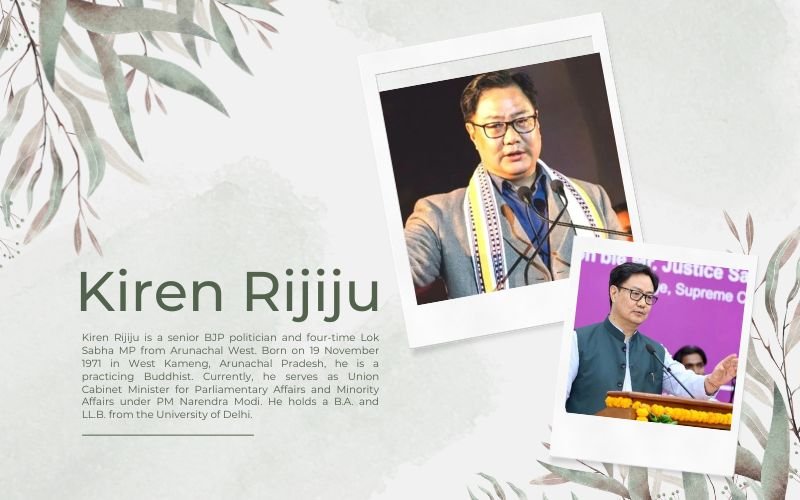
Kiren Rijiju is a senior Indian politician and four-time BJP Member of Parliament from Arunachal West, Arunachal Pradesh. Born on 19 November 1971 in West Kameng district, he follows Buddhism by religion. He holds a B.A. in Political Science from Hansraj College, Delhi, and an LL.B. from Delhi University (1998). He has served as Minister of State for Home Affairs, Minister of Law and Justice, and currently holds the dual portfolio of Union Minister for Parliamentary Affairs and Minority Affairs (since June 2024). His wife is Joram Rina Rijiju, and his declared net worth is ₹4.94 crore.
Disclaimer: The information provided in this article has been compiled from credible and publicly available sources including Wikipedia, the Election Commission of India, PRS India, Press Information Bureau (PIB), official government websites, and reputed national media outlets including ANI, DD News, The Week, Outlook India, and Free Press Journal. Every effort has been made to ensure factual accuracy as of March 2026. However, political portfolios, affiliations, and personal details are subject to change. Readers are encouraged to verify current information through official government channels. This article is intended for informational and educational purposes only and does not represent the official views of any government body, political party, or individual mentioned herein.
Quick Facts: Kiren Rijiju At a Glance
| Detail | Information |
|---|---|
| Full Name | Kiren Rijiju |
| Born | 19 November 1971, Nakhu village, Nafra, West Kameng, Arunachal Pradesh |
| Age (as of 2026) | 54 years |
| Profession / Occupation | Politician, Union Cabinet Minister |
| Famous For | Senior BJP leader; Union Minister of Parliamentary Affairs & Minority Affairs; four-time MP from Arunachal West |
| Father | Rinchin Kharu (first pro-tem Speaker, Arunachal Pradesh Legislative Assembly) |
| Mother | Chirai Rijiju |
| Nationality | Indian |
| Religion | Buddhism |
| Education | B.A. (Political Science), Hansraj College, University of Delhi; LL.B., Campus Law Centre, Faculty of Law, University of Delhi (1998) |
| Political Party | Bharatiya Janata Party (BJP) |
| Constituency | Arunachal West, Arunachal Pradesh |
| Key Achievements | Best Young Parliamentarian (14th Lok Sabha); UN Disaster Risk Champion – Asia Pacific; four-time Lok Sabha MP |
| Spouse | Joram Rina Rijiju (married 2004) |
| Children | Five (sons: Sancho Rijiju + one undisclosed; daughters: Nathey, Jajey, and Mysha Rijiju) |
| Net Worth (Declared) | ₹4.94 crore (as per official EC affidavit) |
| Residence – Delhi | Official ministerial bungalow, New Delhi |
Early Life & Background: The Boy from West Kameng
Childhood in Arunachal Pradesh
Kiren Rijiju was born on 19 November 1971 in the small village of Nakhu, near the town of Nafra in the West Kameng district of Arunachal Pradesh. The region — nestled against the foothills of the Eastern Himalayas and bordering Bhutan — is home to diverse tribal communities and carries a rich Buddhist cultural heritage.
Growing up in this environment had a profound influence on the young Rijiju. He was immersed in the traditions, folklore, and spiritual practices of the Buddhist tribal belt from his earliest years. This cultural foundation would later define not just his personal identity but also his political persona as the recognized voice of Northeast India in Parliament.
Kiren Rijiju young memories are marked by athletic excellence and community engagement. As a student, he was recognized as the best athlete in both his school and college, competing in badminton, football, and athletics at the national level. He participated in the National Games and was honoured with numerous certificates for sports, cultural, literary, and social service activities — an early indicator of the multidimensional public figure he would become.
In 1987, as a teenager, he was a member of the youth and cultural team that participated in the “Festival of India in the U.S.S.R.” held in Moscow — an extraordinary experience for a young man from a remote corner of Northeast India and a formative moment in understanding India’s cultural diplomacy.
Family Background
Kiren Rijiju’s family background is deeply rooted in public service — a legacy that clearly shaped his own political ambitions.
| Family Member | Name | Notable Role / Details |
|---|---|---|
| Father | Rinchin Kharu | First pro-tem Speaker of the Arunachal Pradesh Legislative Assembly |
| Mother | Chirai Rijiju | Private, supportive figure in the family |
| Wife | Joram Rina Rijiju | Associate Professor of History, Dera Natung Government College, Itanagar; gold medalist, Arunachal University; graduate of Lady Shri Ram College, Delhi |
| Son | Sancho Rijiju | Details kept private |
| Son | Undisclosed | Not widely available in public records |
| Daughter | Nathey Rijiju | Details kept private |
| Daughter | Jajey Rijiju | Details kept private |
| Daughter | Mysha Rijiju | Occasionally featured in family moments shared publicly by Rijiju |
His father, Rinchin Kharu, served as the first pro-tem Speaker of the Arunachal Pradesh Legislative Assembly — a pioneering role in the young state’s political architecture. Growing up as the son of such a figure gave Rijiju a front-row view of democratic governance, the responsibilities of elected office, and the weight of representing a people who had only recently gained full statehood (Arunachal Pradesh became a full state in 1987).
Kiren Rijiju Religion: A Buddhist in Indian Politics
Kiren Rijiju Religion and Its Deep Significance
Kiren Rijiju religion is Buddhism — and this is not a peripheral biographical detail. It is central to understanding both his identity and his politics. He was born into a Buddhist family in Arunachal Pradesh’s West Kameng district, a region with strong traditions of Tibetan Buddhism and indigenous tribal Buddhist practice.
In the 18th Lok Sabha (2024–present), Rijiju is one of only three Buddhist MPs — a statistical reality that underscores how disproportionately significant he has become as a voice for Buddhist communities across India. His faith is not a private matter kept separate from his public role; it visibly informs his diplomacy, his ministerial decisions, and his cultural engagements.
His Kiren Rijiju religion background deeply informs his views on Tibet, the Dalai Lama, and India’s cultural diplomacy in the Buddhist world. As a practicing Buddhist and senior Union Minister, he occupies a rare space where spiritual identity intersects with strategic foreign policy — something few Indian politicians can claim with authenticity.
Kiren Rijiju Dalai Lama: A Strategic and Spiritual Bond
The relationship between Kiren Rijiju and the Dalai Lama — and more broadly, India’s official position on the Dalai Lama’s succession — has become one of the most geopolitically charged dimensions of Rijiju’s ministerial career.
In July 2025, Rijiju made a clear and bold statement: only the Dalai Lama himself has the authority to decide his successor. This was a direct rebuff to China’s claim that the next Dalai Lama must be selected through Beijing’s “Golden Urn” method and approved by Chinese officials. China’s Foreign Ministry responded sharply — demanding India refrain from involvement in what it called a Tibetan “internal religious matter.” Rijiju stood firm, framing his position as respect for an established religious convention, not political interference.
In February 2026, Kiren Rijiju backed the Dalai Lama when reports attempted to link the spiritual leader to the Jeffrey Epstein controversy. Rijiju issued a firm statement calling the Dalai Lama’s position a “revered and sacred institution” that must not be maligned or casually linked to such controversies.
In December 2025, Rijiju met a Buddhist delegation from Himachal Pradesh — representing communities from Lahaul, Spiti, Kinnaur, and Dharamshala — at his New Delhi residence. He described the meeting as “a warm and meaningful exchange rooted in harmony, culture and shared values.” Days later, he attended Losar (Tibetan New Year) celebrations at the Central Institute of Buddhist Studies in Ladakh, dancing with students and faculty to traditional music.
In May 2025, Rijiju personally accompanied the Holy Relics of Lord Buddha to Ho Chi Minh City, Vietnam, for the United Nations Day of Vesak celebrations — a powerful act of Buddhist cultural diplomacy from a sitting Union Cabinet Minister who is also a Buddhist by faith.
These actions define Kiren Rijiju not merely as a politician who happens to be Buddhist, but as a public figure for whom Kiren Rijiju religion is a living, active, and diplomatically resonant part of his governance philosophy.
Kiren Rijiju Education: From Delhi University to Parliament
Academic Journey
Kiren Rijiju education followed a path from Arunachal Pradesh to the national capital — a move that exposed him to the highest levels of Indian academic and political life. His time in Delhi was not just about academics; it was about absorbing the rhythms of national discourse.
Rijiju completed his undergraduate education at the prestigious Hansraj College, University of Delhi, earning a Bachelor of Arts (B.A.) degree with a specialization in Political Science. Hansraj College — part of the University of Delhi’s North Campus — has produced numerous distinguished alumni, and it was here that Rijiju’s political instincts were first formally sharpened.
He subsequently pursued legal education, earning his LL.B. (Bachelor of Laws) degree in 1998 from the Campus Law Centre, Faculty of Law, University of Delhi — one of India’s most respected law schools. This legal training would prove essential when he later served as India’s Minister of Law and Justice (2021–2023), making him one of the few Law Ministers to hold an actual law degree from a top national institution.
His Kiren Rijiju education background — combining political science with law — provided the intellectual foundation for a career spanning legislative work, constitutional debates, judicial reform advocacy, and national security policy.
Career Journey: From Arunachal West to the Union Cabinet
Kiren Rijiju’s Political Rise: A Chronological Overview
Kiren Rijiju entered public life through a combination of institutional roles and political positioning that reflected both his family background and personal drive. His career spans four Lok Sabha terms, multiple ministerial portfolios, and a brief but consequential period outside the BJP.
Career Timeline
| Year | Event | Details |
|---|---|---|
| 1987 | Festival of India in USSR | Participated as youth and cultural team member, Moscow |
| 1998 | LL.B. Graduation | Completed law degree, Campus Law Centre, University of Delhi |
| 2000–2005 | KVIC Member | Member, Khadi and Village Industries Commission, Government of India |
| 2004 | First Lok Sabha Victory | Elected from Arunachal West (14th Lok Sabha); BJP debut |
| 2004–2009 | 14th Lok Sabha | Standing Committee on Energy; Best Young Parliamentarian recognition |
| 2008 | Asia Society Recognition | Selected Asian Youth Leader, Youth Conference, Tokyo |
| 2009 | Lok Sabha Defeat | Lost seat; rejected Rajya Sabha offer from Gujarat; briefly associated with INC |
| 2012 | Rejoined BJP | Returned unambiguously to the Bharatiya Janata Party |
| 2014 | Second Lok Sabha Victory | Re-elected from Arunachal West (16th Lok Sabha) |
| 2014–2019 | MoS, Home Affairs | Union Cabinet under PM Modi; designated UN Disaster Risk Champion – Asia Pacific |
| 2019 | Third Lok Sabha Victory | Re-elected from Arunachal West (17th Lok Sabha) |
| 2019–2021 | MoS, Youth Affairs & Sports (Ind. Charge) + Minority Affairs | Led sports infrastructure push; parallel Minority Affairs portfolio |
| 2021–2023 | Union Minister of Law and Justice | Led judicial reform debates; collegium controversy |
| May 2023 | Cabinet Minister, Earth Sciences & Food Processing | Assigned new portfolios after Law Ministry tenure |
| June 2024 | Fourth Lok Sabha Victory | Re-elected from Arunachal West (18th Lok Sabha) |
| June 2024–Present | Union Minister, Parliamentary Affairs & Minority Affairs | 28th Minister of Parliamentary Affairs; 7th Minister of Minority Affairs |
Early Public Service (2000–2004)
Before entering Parliament, Kiren Rijiju served as a Member of the Khadi and Village Industries Commission (KVIC) from 2000 to 2005. This role grounded him in the realities of rural economic development, small-scale industry, and employment generation — issues that remained central to his political messaging throughout his career.
Parliamentary Debut and Early Acclaim (2004–2009)
Rijiju made his parliamentary debut in 2004, winning Arunachal West in the 14th Lok Sabha as a BJP candidate. His debut term was marked by high visibility: multiple national publications named him the Best Young Member of Parliament, and he was appointed to the Standing Committee on Energy and the Consultative Committee for the Ministry of Tribal Affairs.
In 2008, he was selected as one of the Asian Youth Leaders by the Asia Society at its Youth Conference in Tokyo — reinforcing his image as a forward-looking, internationally recognized political talent from the Northeast.
The 2009 Setback and Comeback (2009–2014)
The 2009 general elections brought a significant personal setback: Rijiju lost his Arunachal West seat. The BJP offered him a Rajya Sabha seat from Gujarat as a consolation — a significant gesture reflecting his standing in the party. In a decision that spoke volumes about his character, Rijiju rejected the offer, stating his commitment was to the people of Arunachal Pradesh, not to a lifeline from a distant state.
He briefly associated with the Indian National Congress during this period — a move that has been disputed by Congress leaders of Arunachal Pradesh. Rijiju has maintained he never formally joined the INC, and by 2012 he had unambiguously rejoined the BJP.
Minister of State for Home Affairs (2014–2019)
Re-elected in the 2014 general elections, Rijiju was elevated to Minister of State for Home Affairs — placing him at the center of national security policymaking, border management, and internal affairs. During this tenure, he was designated by the United Nations as a Disaster Risk Champion for the Asia-Pacific Region — the first Indian to receive this distinction, recognizing his work in disaster management policy for a state highly vulnerable to earthquakes and floods.
Kiren Rijiju Ministry of Youth Affairs, Sports & Minority Affairs (2019–2021)
Following the 2019 elections, Rijiju was given the portfolio of Minister of State (Independent Charge) for Youth Affairs and Sports — a role he embraced with visible enthusiasm given his athletic background. He championed sports infrastructure development and became Vice President of the National Archery Association of India. He simultaneously served as Minister of State for Minority Affairs — a combination that foreshadowed his later full Cabinet portfolio in the same domain.
Kiren Rijiju as Law Minister (2021–2023)
Kiren Rijiju’s Ministry of Law and Justice was perhaps the most consequential and controversial chapter of his political career. Appointed as Union Minister of Law and Justice in 2021, he presided over intense debates about judicial independence and the collegium system.
In 2022, Rijiju publicly described the collegium system for judicial appointments as “opaque” — triggering strong pushback from the legal fraternity and opposition parties. He wrote to Chief Justice of India DY Chandrachud, advocating for a greater government role in judicial appointments. In March 2023, he made further headlines accusing some retired judges of being part of an “Anti-India gang” — a remark that drew sharp criticism from legal professionals and civil society groups.
Despite the controversies, his tenure also saw progress on court digitization, legal aid expansion, and alternative dispute resolution mechanisms.
Minister of Earth Sciences (May 2023 – June 2024)
On 18 May 2023, Rijiju was reassigned to the Ministry of Earth Sciences and Food Processing Industries — widely interpreted as a response to the controversies of his Law Ministry tenure. He took on the role with characteristic energy, overseeing initiatives in meteorology, oceanography, seismology, and climate science.
Current Role: Parliamentary Affairs & Minority Affairs (2024–Present)
Following his fourth consecutive electoral victory from Arunachal West in 2024, Shri Kiren Rijiju was appointed to the Union Cabinet as the 28th Minister of Parliamentary Affairs and the 7th Minister of Minority Affairs by Prime Minister Narendra Modi on 10 June 2024.
As Kiren Rijiju Minister for Parliamentary Affairs, he functions as the government’s chief parliamentary manager — coordinating with all parties, managing legislative calendars, and convening all-party meetings ahead of parliamentary sessions. As Minister for Minority Affairs, he oversees welfare schemes for India’s six recognized minority communities: Muslim, Christian, Sikh, Buddhist, Jain, and Zoroastrian/Parsi.
Kiren Rijiju’s Previous Offices: A Complete Portfolio Record
Kiren Rijiju’s previous offices reflect a diverse ministerial journey — unusual in its range across security, sports, law, science, and minority welfare.
| Portfolio | Period | Nature |
|---|---|---|
| Member, Khadi & Village Industries Commission | 2000–2005 | Pre-parliamentary public service |
| Minister of State, Home Affairs | 2014–2019 | Union Cabinet (MoS) |
| MoS, Youth Affairs & Sports (Ind. Charge) | 2019–2021 | Union Cabinet (MoS – Independent Charge) |
| Minister of State, Minority Affairs | 2019–2021 | Union Cabinet (MoS) |
| Union Minister of Law and Justice | 2021–2023 | Full Cabinet |
| Cabinet Minister, Earth Sciences & Food Processing | May 2023–June 2024 | Full Cabinet |
| Union Minister, Parliamentary Affairs | June 2024–Present | Full Cabinet (28th holder) |
| Union Minister, Minority Affairs | June 2024–Present | Full Cabinet (7th holder) |
Major Achievements: A Record of Public Recognition
Kiren Rijiju’s career is distinguished by electoral, diplomatic, and institutional achievements that set him apart from many parliamentary contemporaries:
- Four-time Lok Sabha MP (2004, 2014, 2019, 2024) from Arunachal West — a rare feat in a state with volatile electoral dynamics.
- Best Young Parliamentarian — recognized by multiple national news agencies and English magazines during the 14th Lok Sabha.
- UN Disaster Risk Champion for Asia-Pacific — the first Indian to receive this UN distinction.
- Asian Youth Leader — selected by the Asia Society at its 2008 Youth Conference, Tokyo.
- One of only three Buddhist MPs in the 18th Lok Sabha (2024–present).
- Vice President, National Archery Association of India.
- Led India’s Buddhist cultural diplomacy missions, including accompanying holy Buddhist relics to Vietnam (May 2025).
- Managed Haj 2025 with a historically low fatality rate — down from 220 deaths to 64 — described by Rijiju as “the best Haj the government has conducted in the history of the country.”
- Delivered India’s strongest official statement on Dalai Lama succession in July 2025 — reaffirming that only the Dalai Lama can decide his successor.
Personal Life: The Man Behind the Minister
Kiren Rijiju Wife and Family Life
Kiren Rijiju’s wife, Joram Rina Rijiju, is in many ways his intellectual equal. The couple married in 2004 — the same year Rijiju entered Parliament for the first time. She is a graduate of the prestigious Lady Shri Ram College for Women, New Delhi, and earned a gold medal from Arunachal University.
Today, Joram Rina Rijiju serves as an Associate Professor of History at Dera Natung Government College, Itanagar, Arunachal Pradesh — contributing to higher education in their home state while her husband manages national affairs from Kiren Rijiju’s residence in Delhi.
Together, they have five children: sons Sancho Rijiju and one whose name remains private, and daughters Nathey, Jajey, and Mysha Rijiju. Rijiju occasionally shares family moments publicly — including a heartwarming video featuring his daughter Mysha — but generally keeps his children’s lives shielded from media attention.
Kiren Rijiju Young: Athletic, Adventurous, Culturally Rich
Those who knew Kiren Rijiju young describe a man of remarkable energy and wide-ranging curiosity. He was a formidable multi-sport athlete — competing in badminton, football, and athletics — and was named the best athlete in both his school and college. His adventurousness extended to culture: the 1987 Moscow trip as a teenager marked the beginning of a lifelong interest in India’s cultural soft power.
He is known for visiting lesser-known corners of India, engaging with diverse communities, and writing on social, cultural, and political issues in newspapers and magazines. He has a particular interest in Strategic and Security Affairs — a domain that shaped his productive tenure in the Ministry of Home Affairs.
Interests and Hobbies
Rijiju leads a disciplined lifestyle with consistent attention to physical fitness. His interests span reading, travel, exploring indigenous cultural traditions, engaging with youth at universities and NCC programs, classic film, folk music, and literature — a well-rounded personality that defies the stereotypical image of a career politician.
Kiren Rijiju Residence – Delhi
As a Union Cabinet Minister, Kiren Rijiju’s residence in Delhi is an official government bungalow befitting his Cabinet rank. He regularly hosts Buddhist delegations, party colleagues, and community representatives here — including the December 2025 meeting with Buddhist representatives from Lahaul, Spiti, Kinnaur, and Dharamshala, as well as numerous all-party pre-session consultations in his capacity as Parliamentary Affairs Minister.
Net Worth: Declared Assets and Financial Profile
Kiren Rijiju’s financial profile is a matter of public record. As per his official election affidavit filed with the Election Commission of India, his declared net worth stands at approximately ₹4.94 crore — reflecting the declared assets of a career politician with over two decades in public office.
This figure is verified through the Election Commission of India’s mandatory asset disclosure system. As of early 2026, no updated affidavit data beyond ₹4.94 crore has been confirmed in publicly available official records.
As a Union Cabinet Minister, Rijiju receives an official salary, residential accommodation, official vehicles, and ministerial support staff — benefits that come with the rank rather than personal wealth accumulation.
Influence: The Voice of Northeast India
Political Influence
Kiren Rijiju’s influence in Indian politics extends well beyond his formal ministerial portfolios. He is widely recognized as one of the most credible voices of Northeast India in the national political arena — a region historically underrepresented in Union Cabinet politics.
His ability to win four successive Lok Sabha elections from Arunachal West — in a state where party loyalties shift frequently — is itself a mark of exceptional local influence. He has built a political brand combining nationalist BJP credentials with genuine cultural rootedness: a combination that appeals both to his base in Arunachal Pradesh and to a broader constituency across the Himalayan and Buddhist belt.
Cultural Diplomacy and Buddhist Statecraft
As a Buddhist Union Minister, Rijiju has become an informal but powerful symbol of India’s Buddhist cultural diplomacy — particularly in relations with the Tibetan diaspora, Himalayan Buddhist communities, and Buddhist nations of Southeast and East Asia. His accompaniment of Buddhist holy relics to Vietnam (2025), his celebration of Losar with Ladakhi students, his meetings with Buddhist delegations from Himachal Pradesh, and his firm stand on Dalai Lama succession collectively constitute a coherent diplomatic doctrine rooted in personal faith and national interest.
Parliamentary Management
In his current role as Minister of Parliamentary Affairs, Rijiju is the government’s primary interface with all political parties in Parliament — convening all-party meetings, managing legislative calendars, and serving as the government’s spokesperson on parliamentary strategy. His handling of sensitive bills, including the Waqf Amendment Bill of 2025, has placed him at the centre of India’s most contentious legislative debates.
Recent Updates: Kiren Rijiju in 2025–2026
The 2025–2026 period has been one of the most active in Kiren Rijiju’s ministerial career:
Haj 2025 (July 2025): Rijiju chaired the comprehensive Haj Review Meeting, declaring Haj 2025 “the best Haj in the country’s history,” citing a dramatic reduction in pilgrim fatalities (from 220 to 64) and improved inter-ministerial coordination. He began planning Haj 2026, including a proposed 20-day short-duration Haj package and Haj Suvidha smart wristbands with health monitoring and emergency alert features.
Dalai Lama Succession (July 2025): Rijiju firmly stated that only the Dalai Lama can decide his successor — drawing a sharp reaction from China’s Foreign Ministry but strong support from Tibetan Buddhist communities and international observers of religious freedom.
Dalai Lama–Epstein Row (February 2026): Rijiju backed the Kiren Rijiju Dalai Lama institution publicly when reports attempted to link the spiritual leader to the Jeffrey Epstein controversy, calling for protection of “sacred institutions” from political misuse.
Young Leaders Forum (November 2025): Rijiju addressed the Young Leaders Forum 2025 at Manekshaw Centre, New Delhi, on National Unity Day — urging India’s youth to play a central role in national security and the vision of Viksit Bharat @2047.
Buddhist Delegation (December 2025): He hosted Buddhist representatives from Lahaul, Spiti, Kinnaur, and Dharamshala at his Kiren Rijiju residence Delhi — reinforcing deep engagement with Himalayan Buddhist communities.
Operation Sindoor (2025–2026): Following India’s military response to cross-border terrorism, Rijiju as Parliamentary Affairs Minister managed the parliamentary debate — warning opposition parties against statements that could “demoralise the Indian armed forces.”
Electoral Roll Revision (December 2025): Rijiju signalled the government’s willingness to discuss concerns around the Special Intensive Revision (SIR) of electoral rolls, calling for bipartisan cooperation in Parliament.
Conclusion
The biography of Shri Kiren Rijiju is the story of a man who has refused to be defined by a single dimension. He is simultaneously a tribal Buddhist from the hills of Arunachal Pradesh and a senior Union Cabinet Minister navigating the highest levels of national governance. He is a man of deep faith who defends the Dalai Lama’s institution and a legal graduate who argued with the Supreme Court collegium. He is a former national-level athlete and a policy thinker who has shaped legislation across five distinct ministerial domains.
Kiren Rijiju religion — Buddhism — is not incidental to his public life; it is integral to it. It informs his diplomacy, his community outreach, and his personal identity in a way that makes him genuinely unique among India’s senior politicians. His trajectory — from a village near Nafra to the Union Cabinet — is not merely a personal achievement but a symbol of what India’s Northeast can contribute to national governance when given the platform, the preparation, and the opportunity.
With the BJP firmly in power and Rijiju holding dual portfolios of strategic importance, he remains — as of March 2026 — one of the most consequential, culturally distinctive, and diplomatically active political figures in contemporary Indian politics.
FAQ: Frequently Asked Questions About Kiren Rijiju
Q1. What is Kiren Rijiju’s religion?
Kiren Rijiju religion is Buddhism. He was born into a Buddhist family in the West Kameng district of Arunachal Pradesh and is a practicing Buddhist. He is one of only three Buddhist MPs in the 18th Lok Sabha (2024–present) and is closely associated with Buddhist cultural diplomacy at the national level.
Q2. Who is Kiren Rijiju and what ministry does he currently hold?
Kiren Rijiju is a senior BJP politician and four-time Member of Parliament from Arunachal West, Arunachal Pradesh. As of 2026, he serves as the Union Cabinet Minister for Parliamentary Affairs (28th holder) and Minority Affairs (7th holder) in the Government of India under Prime Minister Narendra Modi.
Q3. What is Kiren Rijiju’s educational qualification?
Kiren Rijiju education includes a Bachelor of Arts (B.A.) in Political Science from Hansraj College, University of Delhi, and an LL.B. degree earned in 1998 from the Campus Law Centre, Faculty of Law, University of Delhi.
Q4. Who is Kiren Rijiju’s wife?
Kiren Rijiju’s wife is Joram Rina Rijiju, married in 2004. She is a gold medalist from Arunachal University, a graduate of Lady Shri Ram College, New Delhi, and an Associate Professor of History at Dera Natung Government College, Itanagar. There is no verified information about a “Kiren Rijiju first wife” — all credible records confirm Joram Rina as his only spouse.
Q5. What is Kiren Rijiju’s declared net worth?
As per his official election affidavit filed with the Election Commission of India, Kiren Rijiju’s declared net worth is approximately ₹4.94 crore — the only officially verified figure available in public records.
Q6. What is the significance of the Kiren Rijiju–Dalai Lama relationship?
Kiren Rijiju Dalai Lama engagement is among the most geopolitically significant aspects of his ministerial career. As a Buddhist Union Minister, he stated in July 2025 that only the Dalai Lama can decide his successor — directly challenging China’s position. He also defended the Dalai Lama against the Epstein controversy link in February 2026 and has personally attended Buddhist events honouring the Dalai Lama’s tradition across India.
Q7. What are Kiren Rijiju’s previous offices?
Kiren Rijiju’s previous offices include: Member, KVIC (2000–2005); Minister of State for Home Affairs (2014–2019); MoS for Youth Affairs & Sports – Independent Charge (2019–2021); MoS for Minority Affairs (2019–2021); Union Minister of Law and Justice (2021–2023); Cabinet Minister for Earth Sciences and Food Processing Industries (2023–2024); and currently Union Minister for Parliamentary Affairs and Minority Affairs (June 2024–present).
Check out her instagram here :- @kiren.rijiju
Thank You: Thanks for reading! Want more inspiring stories? Check out our previous blog on Mallikarjun Kharge Caste Biography 2026: From Dalit Roots to Congress Power
